Category: Past
-

High-dimensional Bell nonlocality in many-body systems
Dr. Matteo Fadel, SNSF Ambizione Fellow at ETHZ Bell nonlocality is among the strongest forms of correlation, capturing departures from classical intuition that are revealed through the violation of Bell inequalities. Yet deriving Bell inequalities is itself a formidable mathematical task, which has often been limited to scenarios involving only a few parties. In this…
-

Unconventional superconductivity – Aspects of Symmetry and Topology
Prof. em. Dr. Manfred Sigrist, Professor Emeritus at the Department of Physics Unconventional superconductivity typically emerges in materials with strong electron correlations, frequently in close proximity of magnetic instabilities. This talks aims to elucidate the main distinctions between conventional and unconventional superconductors. Theoretical considerations underline the pivotal significance of symmetry, offering insights that guide experimental…
-

A matter of time, gravity and galaxies
Dr. Sveva Castello, Postdoctoral Fellow at the Max Planck Institute for Astrophysics (Garching, Germany) Our understanding of the Universe relies on two pillars, gravity and dark matter. These are involved in compelling open questions: is the accelerated cosmic expansion due to gravity modifications? And does dark matter experience gravity in the same way as normal…
-

Emergent Time, Emergent Space
Prof. Dr. Daniele Oriti, Professor of Theoretical Physics, Universidad Complutense de Madrid What is time? What is space? Our best current theory of gravity, i.e. General Relativity, teaches us that gravity is spacetime geometry, thus that spacetime itself is a physical system. Moreover, we have by now many reasons to believe that we need to…
-
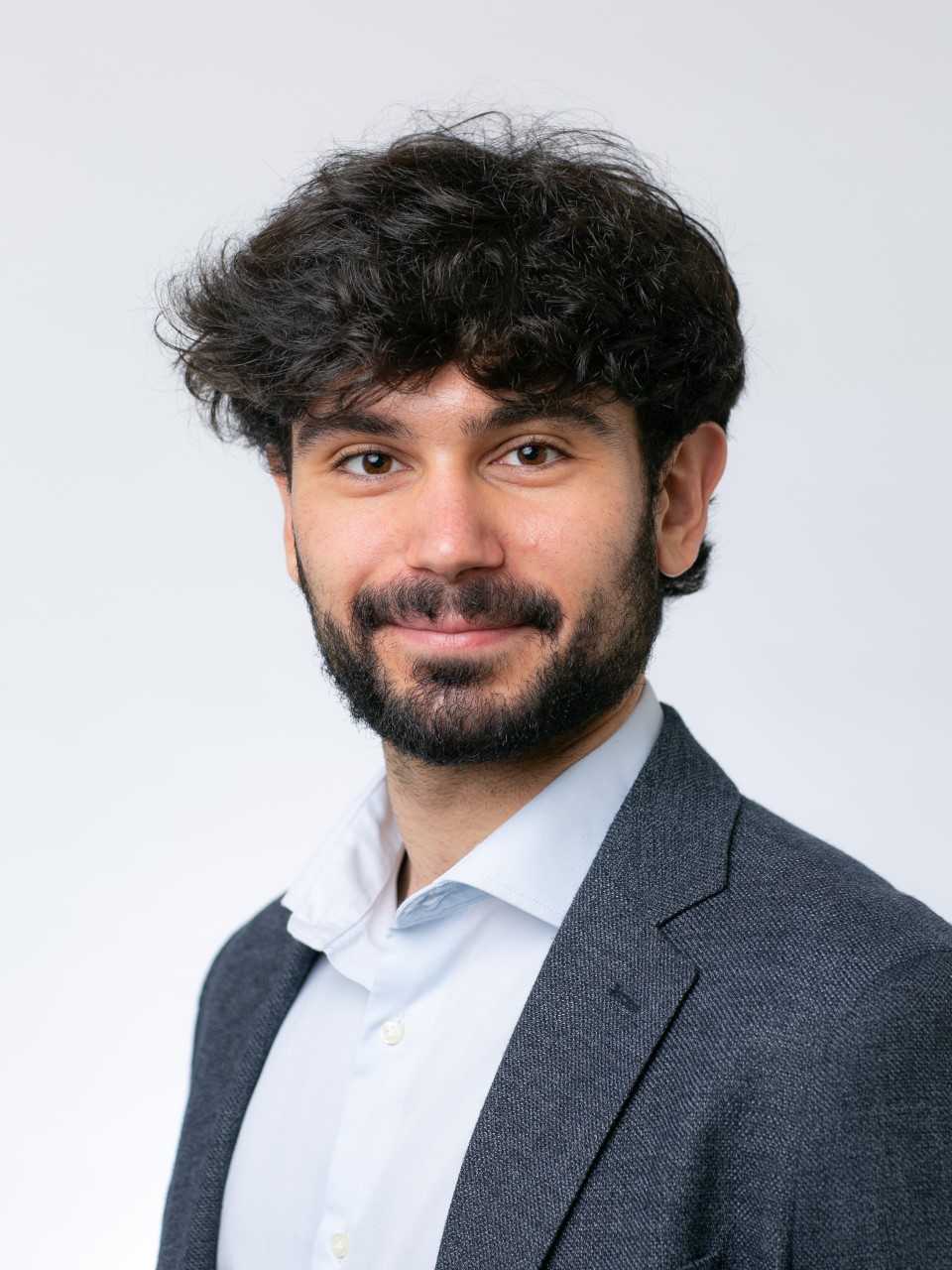
From Scattering Amplitudes to the Cosmological Large Scale Structure: Numerical Methods in the EFTofLSS
Andrea Favorito, PhD Student at Institute for Theoretical Physics, ETH Zürich Surveys of the large-scale structure of the Universe are becoming increasingly precise. A key theoretical framework for interpreting this data and constraining cosmological models is the Effective Field Theory of Large-Scale Structure (EFTofLSS), a particle-physics–inspired approach to modelling cosmic clustering beyond linear order. In…
-

Challenges and Breakthroughs in the Mathematics of Plasmas
Prof. Dr. Mikaela Iacobelli, Associate Professor of Mathematics, ETH. This talk will explore some fundamental issues in the mathematics of plasmas, focusing on the stability and instability of solutions to Vlasov-type equations, which are crucial for describing the behavior of charged particles in a plasma. A general introduction to kinetic theory is given, making the…
-

Same, but different: integrals and transforming (career) paths
Dr. Simon León Krug, Postdoc at Dep. of Chemistry and Applied Biosciences, ETH Zürich Theoretical physics is a multi-faceted field encompassing an abundance of disciplines, often times only sharing one language: math. Of particular importance for my research since my Master’s has been complex analysis, in particular integrals. Although I changed disciplines twice since then,…
-

Quantum Computing and Simulation in the presence of errors
Prof. Dr. Ignacio Cirac, Director of Max-Planck Institute for Quantum Optics Advancements in quantum computing have enabled the development of small-scale quantum computers and simulators that adhere to the principles of quantum physics. Despite its rapid progress, those devices are not yet flawless and errors accumulate, posing serious challenges to their application to interesting problems.…
-

Student Talks
Leonardo Valente, MSc Physics at ETH Zürich Alexander Roth, MSc Physics at ETH Zürich, Research Assistant at Max Planck Institute for Quantum Optics Bartłomiej Leks, MSc Material Science ETH Zürich Decoherence in Quantum Reference Frames (Leonardo Valente): We explore the phenomenon of decoherence and how it changes under quantum reference frame (QRF) transformations. In particular,…
-

Ghost stories: from Faddev-Popov to Batalin-Vilkovisky
Orev Malatesta, PhD candidate with Cattaneo Group, University of Zürich Every gauge symmetry hides a ghost. What begins in quantum field theory as a computational fix – the Faddeev-Popov trick, which introduces extra “unphysical” fields called ghost fields to keep our path integrals well-behaved – evolves in BRST symmetry into a systematic algebraic framework where…